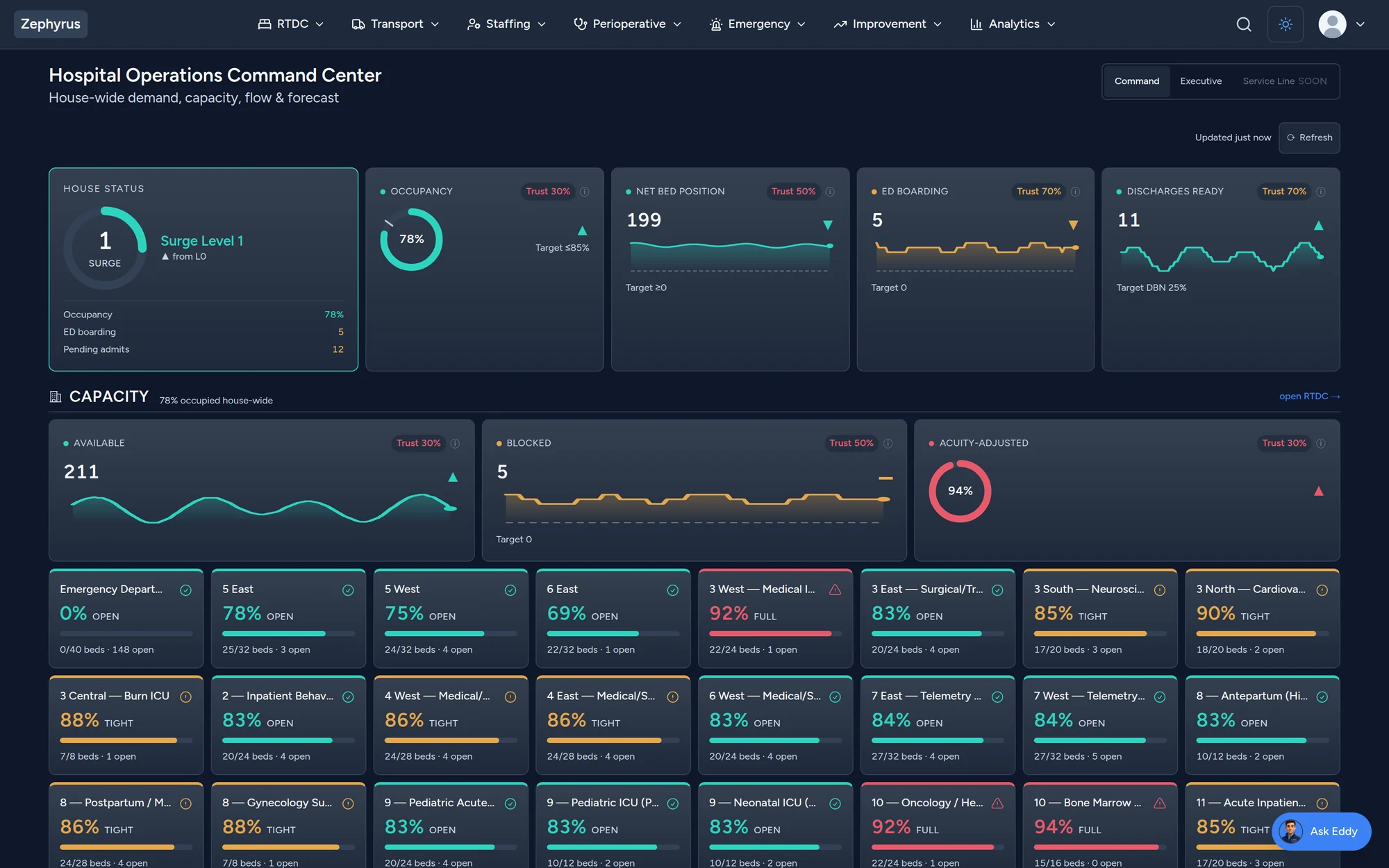
A hospital is a flow problem disguised as a building. Beds, operating rooms, and emergency-department bays are the constraints; demand arrives unscheduled; and the cost of misjudging capacity shows up as boarding, diverted ambulances, and canceled surgeries. Zephyrus is the real-time operations layer that makes that flow visible — and, increasingly, anticipates it.
A command center that computes from live data
The house-wide command center now computes from a live, seeded database rather than mock fixtures — occupancy, boarding, discharges, and unit-by-unit status across a 500-bed system, organized on a Donabedian-structured wall of structure, process, and outcome. The demonstration data is unified on Summit Regional Medical Center, a synthetic 25-unit academic medical center grounded in real-world distributions, so every number on the screen is internally consistent.
Four services, one system
Beneath the command center sit the working modules: emergency-department throughput with triage acuity and door-to-provider tracking; Real-Time Demand & Capacity modeling with census, admission, and discharge forecasts; perioperative management with OR utilization and block compliance; and nursing operations and staffing analytics. A process-improvement layer tracks throughput and length-of-stay over time — the SPC and PDSA discipline that turns operational data into sustained change.
Eddy comes aboard
The headline of this cycle is Eddy — a process-aware AI agent now enabled in production. Eddy runs against a local MedGemma model with hybrid retrieval over the platform's own operational knowledge, and it ships behind a PHI-free approval doorbell so that any action it proposes is reviewed before it lands. Alongside it, real-time WebSocket updates now reach a native mobile companion, so a capacity alert raised on the floor shows up in a clinician's pocket within seconds.
What's next
The forward plan collapses today's several dashboards into one “Operations Cockpit” with a single altitude model — from a house-wide glance down to a single unit — reconciled onto a consistent visual language. The serving layer and the agent loop that the cockpit needs already exist; the work ahead is composition, not invention.
 Sanjay M. Udoshi MD
|
Sanjay M. Udoshi MD
|