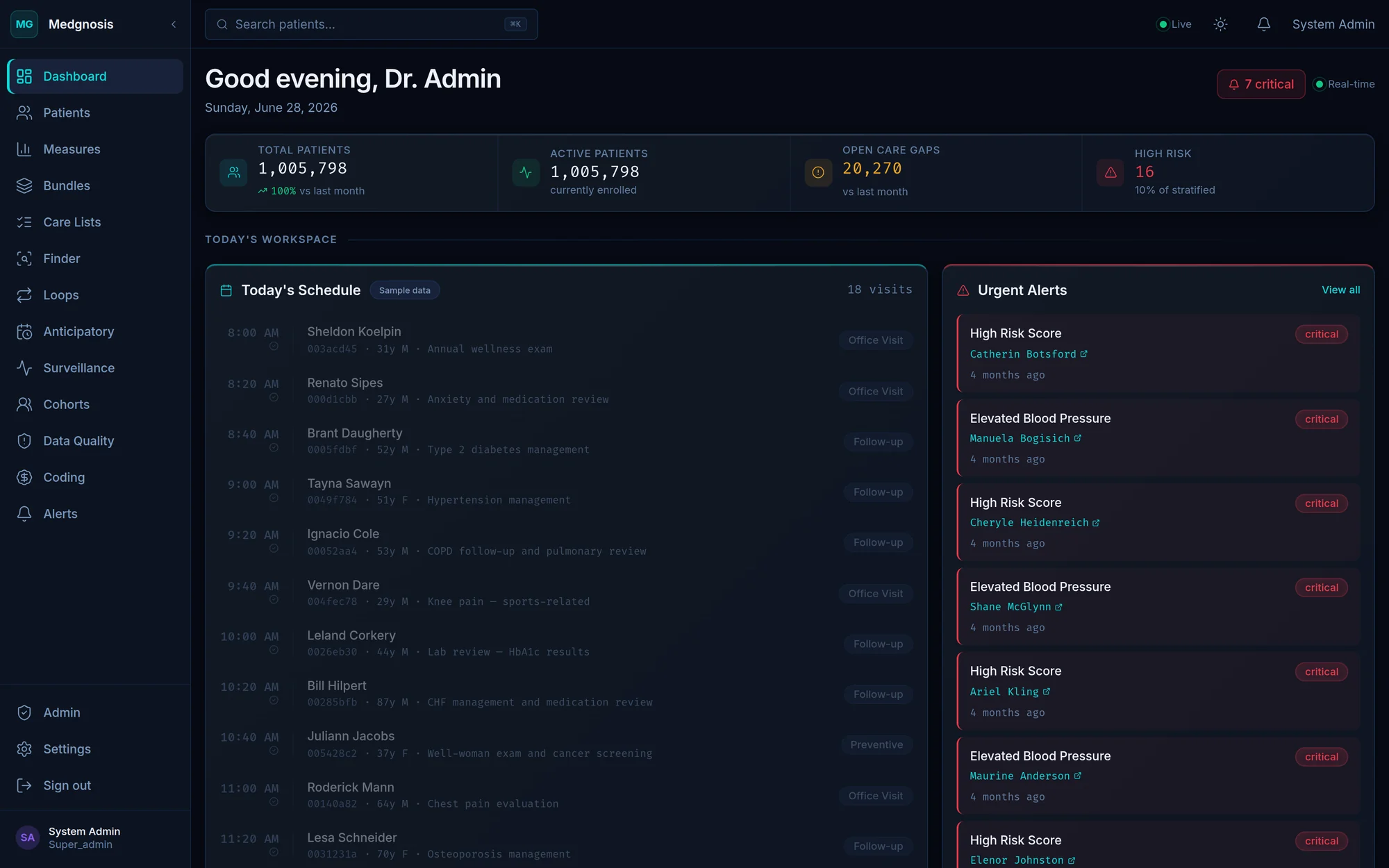
Most population-health tools force an organization to maintain the same clinical logic in three places: once for quality measurement, once for prospective care gaps, and once for any decision support embedded in the workflow. Medgnosis was built on the opposite premise — that a single, governed clinical logic layer should drive all three. That premise is now running in production.
Where it stands
Medgnosis pairs a 1M+ patient hybrid warehouse — a third-normal-form EDW alongside a Kimball star schema — with a real-time care-gap engine spanning 45 condition bundles and 354 measures. A catalog of 750+ measures executes nightly as governed SQL, each rolled up with Wilson confidence intervals so that the numbers carry their own uncertainty rather than hiding it. Every measure is inspectable down to its numerator and denominator.
Standards, not black boxes
The platform exposes a live CDS Hooks 2.0 discovery endpoint with patient-view and order-sign services, and FHIR R4 resources (Patient, Condition, Observation, MedicationRequest, and $everything). Terminology is anchored by VSAC value sets — on the order of 1,500 sets and 225,000 codes — with per-period version pinning, so a measure computed for 2024 uses the value sets that were authoritative in 2024. Risk scoring is evidence-based and governed: CHA₂DS₂-VASc, NEWS2, MEWS, and peers, not opaque proprietary models.
What shipped recently
Recent work brought the platform to production readiness: single sign-on through Authentik now gates access, full-text clinical search is indexed and serving, and a clinical-decision-support compendium — distilled from a large health system's CDS library — was reconciled into the measure set. Patient-identity resolution (an enterprise master patient index) reached its first integration milestone, and the platform was registered against the Epic sandbox for standards-based connectivity.
What's next
The roadmap is deliberately standards-first: CQL execution behind the existing evaluator seam, QI-Core profiling, FHIR digital quality measures ($evaluate-measure and MeasureReport), and Da Vinci DEQM prospective gaps-in-care. We won't claim CQL execution before it is proven against test-deck-validated measures — honesty about what is shipped versus what is in flight is part of the design.
 Sanjay M. Udoshi MD
|
Sanjay M. Udoshi MD
|