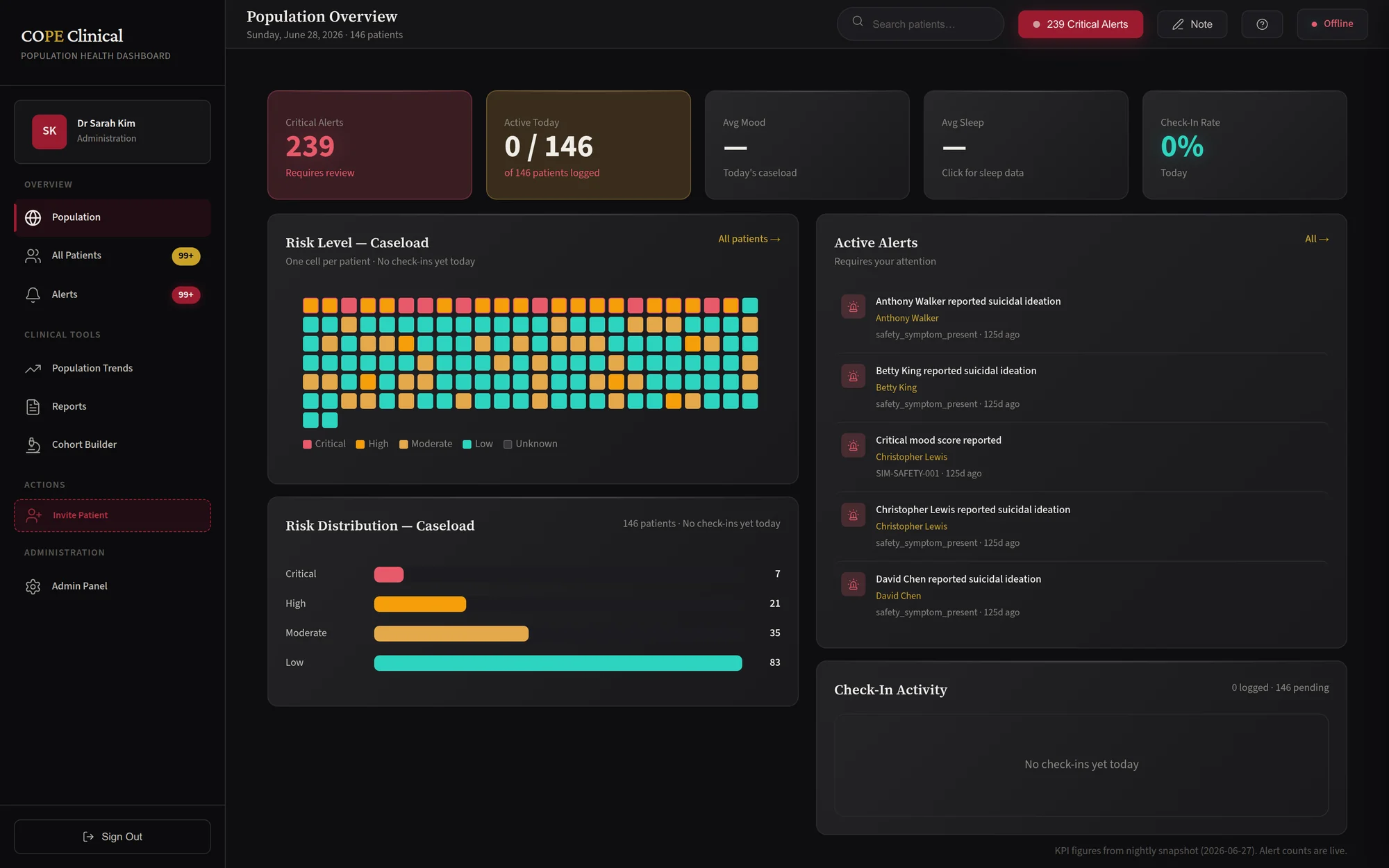
Behavioral health lives between visits. A patient with depression, anxiety, or bipolar disorder spends fifty minutes a month with a clinician and the rest of the month on their own — and that is exactly where deterioration hides. COPE (formerly MindLog) was built to close that gap, pairing a native patient app with a clinician command center so that the signal between visits actually reaches the person who can act on it.
Where it stands
Patients log daily mood, sleep, exercise, medication adherence, triggers, and symptoms through a React Native app. Clinicians monitor their whole caseload through a web dashboard organized around validated instruments — PHQ-9, GAD-7, ISI, C-SSRS, ASRM, and WHODAS 2.0 — with a population view that ranks who needs attention today. Real-time alerts surface critical signals over WebSockets the moment they are reported, and clinical reports generate automatically for office visits.
Built for safety and trust
Safety is not a feature bolted on at the end. The 988 Suicide & Crisis Lifeline and Crisis Text Line are integrated throughout, and the C-SSRS pathway is treated as a first-class clinical workflow rather than a checkbox. Authentication is first-party — bcrypt against the platform's own store, with no third-party identity vendor in the loop — and clinician access now runs through single sign-on with Authentik.
Interoperable by design
Everything a patient records can leave COPE as FHIR R4 — Observation, MedicationRequest, QuestionnaireResponse, and Consent — so the longitudinal picture COPE assembles can travel back into the EHR rather than staying trapped in a silo. The rename from MindLog to COPE reflected that maturation: a production deployment, its own clinical database, and a clear identity as a behavioral-health monitoring platform.
What's next
The next chapter deepens the EHR integration and the longitudinal record — turning thousands of daily check-ins into a trend a clinician can act on, and making COPE a dependable instrument in the spaces between appointments where care so often falls through.
 Sanjay M. Udoshi MD
|
Sanjay M. Udoshi MD
|