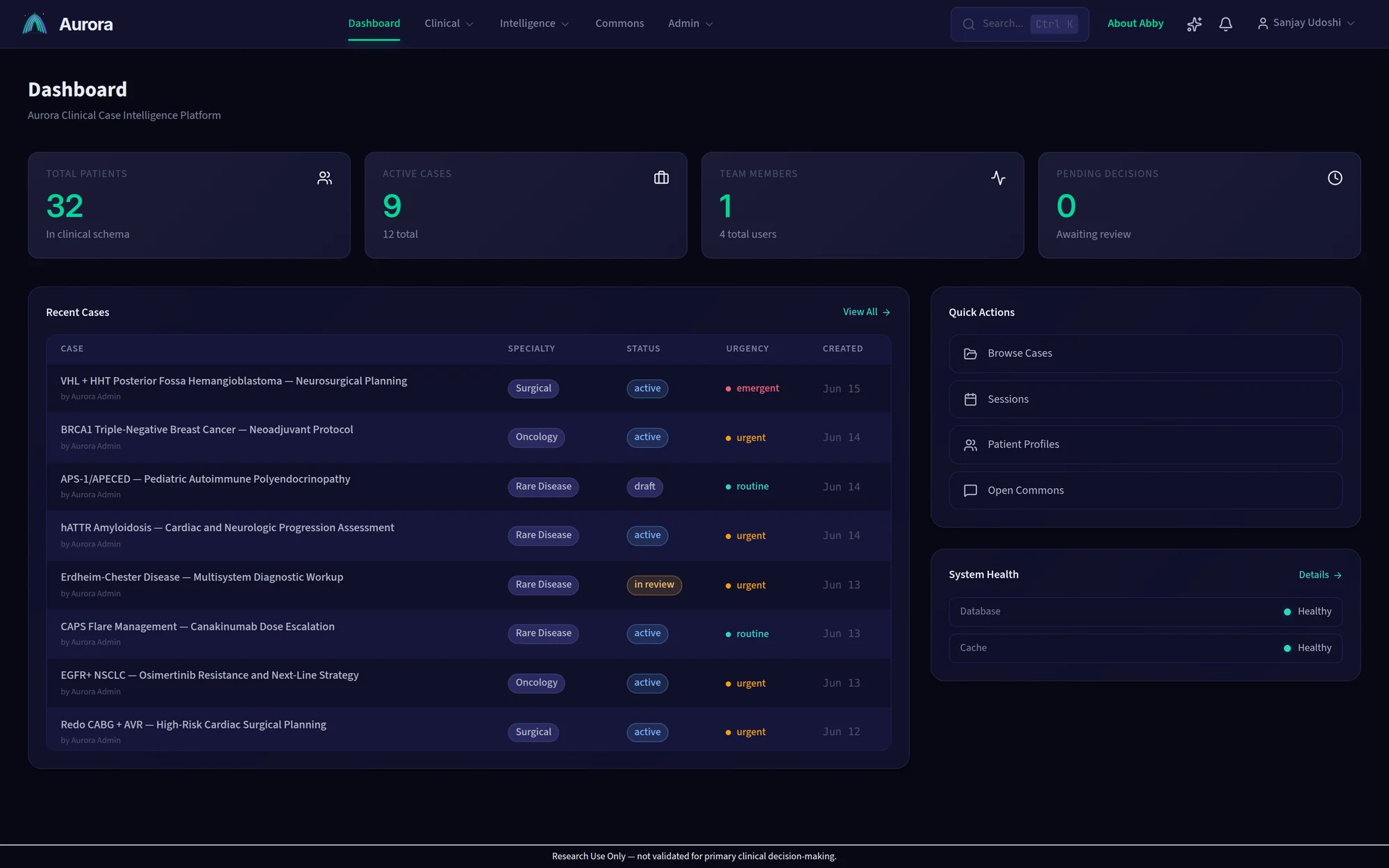
Aurora has reached general availability. What began as a molecular tumor board has grown into a vendor-agnostic operating system for multidisciplinary teams working the hardest cases — from precision oncology to rare disease — built throughout on OMOP, FHIR R4, and GA4GH standards. The v2.0.0 release marks the platform's transition from project to product.
What general availability means
Teams run live tumor-board sessions with case queues, presenter assignment, and real-time session status. Genomic variants are interpreted against ClinVar with OncoKB gene–drug matching; longitudinal imaging is reviewed in an embedded DICOM viewer with tumor segmentation and RECIST response tracking (CR/PR/SD/PD). Every recommendation is captured as a structured, auditable decision with multi-team voting and follow-up tracking — not a free-text note that evaporates after the meeting.
A deliberate rare-disease lead
Rather than chase one tumor type, Aurora leads with rare disease and a horizontal multidisciplinary-team core, then layers population packs on top. That direction shipped as a coherent set of capabilities: genomic reanalysis, GA4GH Variation Representation, a genomic data viewer, a patient-matchmaking workflow, and a Beacon-style discovery interface — the standards-and-evidence path to making vanishingly rare cases findable.
Collective intelligence, privately
Aurora's most distinctive capability is federated “Patients Like This” — the ability to ask, across institutions, whether anyone has seen a case like the one in front of you, without moving protected health information. Queries run under k-anonymity with mutual TLS, returning aggregate signal rather than identifiable records. An AI copilot supports the work throughout: trial eligibility, guideline concordance, drug-interaction checks, and variant summaries.
What's next
With OIDC authentication, real-time updates, and background processing live in production, focus turns to expanding the population packs and deepening the real-world-evidence loop — so that the structured decisions a board makes today become queryable evidence for the next board, anywhere in the network.
 Sanjay M. Udoshi MD
|
Sanjay M. Udoshi MD
|